RNA purification is one of the most technically sensitive steps in molecular biology workflows. Speed is often viewed as a compromise on quality, with the perception that shorter protocols may sacrifice RNA integrity, reproducibility or downstream performance.
This perception is largely rooted in traditional TRIzol®-based RNA extraction workflows. These methods require time-consuming manual steps and careful phase handling to maintain RNA quality. For laboratories processing multiple samples, or if protocols are executed by various laboratory operators, this can introduce unnecessary complexity and variation.
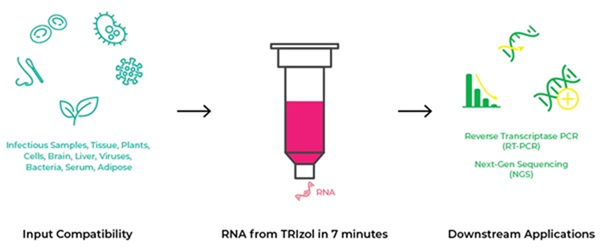
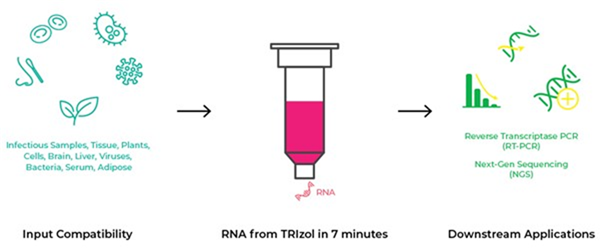
Zymo Research's Direct-zol™ technology challenges the premise that faster RNA purification must come at the expense of quality. Direct-zol™ enables RNA to be purified directly from TRIzol® samples, reducing handling steps and supporting the extraction of high-quality RNA in as little as 7 minutes.
Traditional TRIzol workflows
Traditional TRIzol® workflows are widely used, but the process includes several manual steps that require careful execution:
- Phase separation and precipitation
- Multiple tube transfers
- Careful recovery of the aqueous phase
- Pellet washing and drying
- Approximately 30 to 60 minutes of workflow time
When these steps are repeated across many samples, small differences in handling can influence the consistency of the final RNA preparation.
Direct-zol workflows
Direct-zol™ simplifies RNA purification by allowing RNA to bind directly from TRIzol® samples. In practice, this means researchers can:
- Bind RNA directly from TRIzol®
- Eliminate phase separation steps
- Remove the need for precipitation and pellet drying
- Reduce tube transfers and hands-on handling
- Complete the workflow in as little as 7 minutes
- Support consistent, high-quality RNA for downstream applications
Workflow comparison
| Process step | Traditional TRIzol® workflow | Direct-zol workflow |
| Sample lysis | Lyse sample in TRIzol® | Lyse sample in TRIzol® |
| Phase separation | Add chloroform, shake, incubate and centrifuge to form aqueous, organic and interphase layers | Not required |
| Aqueous phase recovery | Carefully aspirate the upper aqueous phase while avoiding contamination from other layers | Not required, as the full TRIzol® mixture proceeds directly to binding |
| RNA precipitation | Add isopropanol, incubate and centrifuge to pellet RNA | Not required; RNA binds directly to the column |
| Pellet washing | Wash RNA pellet with 75% ethanol | Wash column with provided buffers; no pellet handling |
| Pellet drying | Air-dry pellet, with risk of over-drying or under-drying | Not required; no pellet is formed |
| DNase treatment | Performed off-column; additional handling required | Performed directly on-column (optional, streamlined) |
| RNA elution | Resuspend RNA pellet in water or buffer | Elute RNA from the column into RNase-free water or buffer |
| Hands-on time | Approximately 30–60 minutes, with multiple manual steps | As little as 7 minutes, with fewer handling steps |
| Workflow variability | Higher, due to several technique-sensitive steps | Lower, due to reduced operator-dependent handling |
Removing steps without cutting corners
Direct-zol™ accelerates RNA purification not by cutting corners, but by removing them. By avoiding phase separation, RNA precipitation and pellet drying, the workflow reduces several points where technical variation can arise.
This matters because:
- Phase separation can be influenced by sample type, pipetting technique or timing
- Precipitation efficiency can vary depending on temperature and alcohol ratios
- Pellet washing and drying introduce further opportunities for inconsistency
- Repeated tube transfers can increase handling complexity
By bypassing these steps, Direct-zol™ helps reduce technical variation that may affect downstream gene expression measurements. This can be especially valuable in high-throughput environments or when processing heterogeneous samples.
Direct-zol™ is designed to support downstream applications such as RT-qPCR and RNA-seq library preparation. The workflow also supports the recovery of smaller RNAs, including miRNAs.
Accelerating discovery without sacrificing scientific standards
RNA extraction is a foundational step in many molecular workflows. Faster and more reproducible purification can have a direct impact on research timelines by reducing hands-on time and helping data become available sooner for interpretation and decision-making.
This can help laboratories:
- Shorten pilot studies
- Process samples more consistently
- Support faster data generation
- Manage multi-sample workflows more efficiently
These gains become particularly relevant in multi-day or multi-sample studies, where workflow efficiency can meaningfully influence project momentum.
Conclusion
The idea that speed and quality are mutually exclusive in RNA purification is rooted in the limitations of traditional, manual workflows rather than a fundamental scientific trade-off.
Direct-zol™ demonstrates that by eliminating some of the most error-prone steps of the traditional TRIzol® workflow, researchers can purify RNA in a fraction of the time, with greater workflow consistency and confidence.
Do you have a workflow where Direct-zol™ could help reduce hands-on time or improve consistency? Sanbio can help you evaluate whether this Zymo Research solution fits your sample type, throughput and downstream application.
Contact our specialists for advice or request a Direct-zol™ sample to experience a faster, more streamlined RNA purification workflow in your own lab.
TRIzol® is a registered trademark of Molecular Research Center, Inc.